
Being an avid builder for the better part of 15 years, I’m occasionally asked for advice on how to pursue a similar career. So, here is a hot tip for the aspiring builders: keep in mind that we are no longer just snapping 2x4 bricks together. We are operating in an era of Infinite Complexity, where a single transparent slope-piece can derail a multi-thousand piece project, and the instruction manuals are written in a language that changes between building steps.
What follows is a highlight of the structural failures you are bound to encounter as you move toward more elaborate builds. This list is by no means exhaustive, but it represents the scars and cumulative wisdom of the Master Builders I’ve had the honour to collaborate with.
The “Star Wars” tax and the Premium of Hype
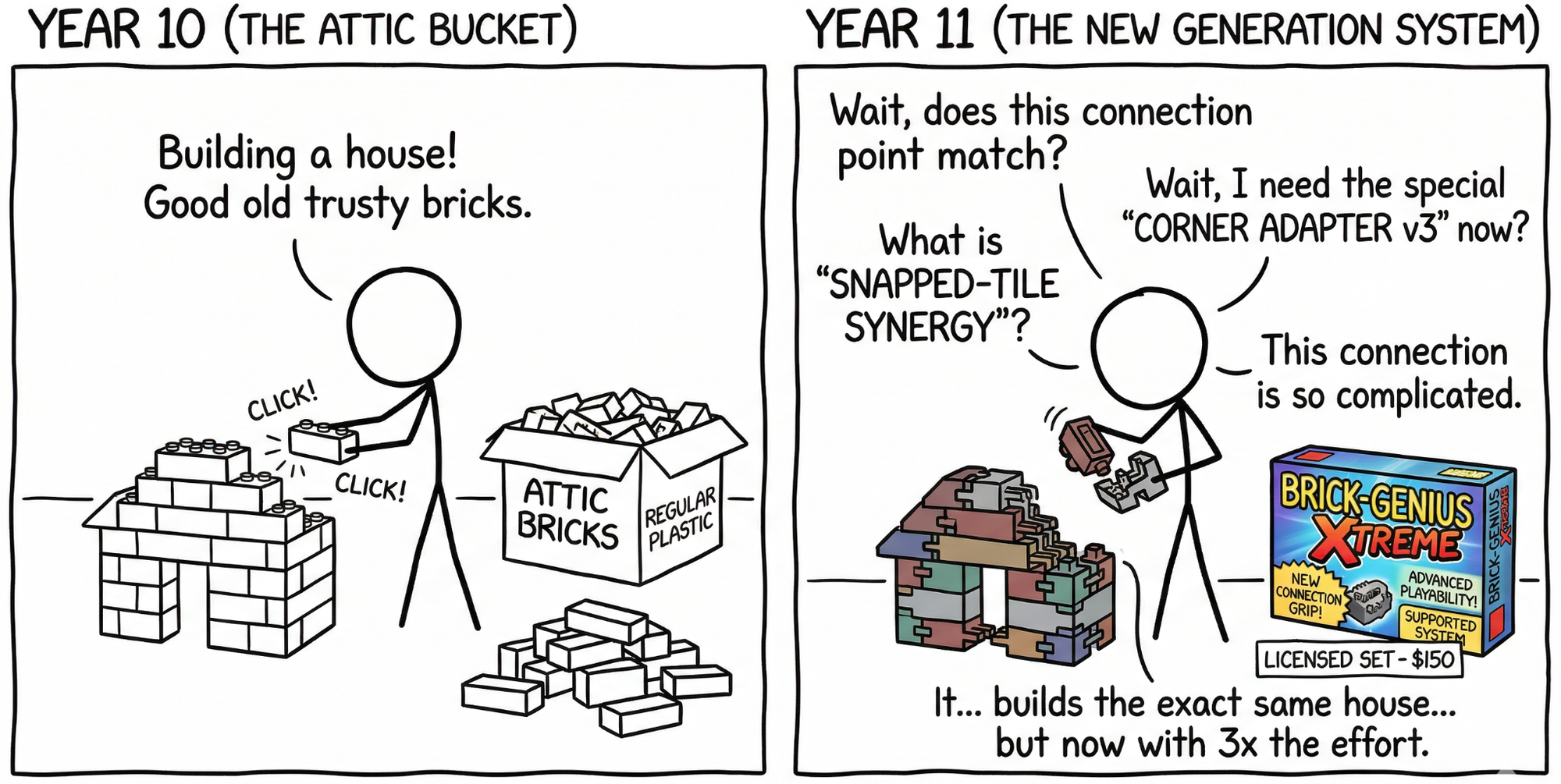
Every year, a “New Generation” of bricks is released, usually accompanied by a glossy manual and a marketing campaign that promises “improved connection grip” and “incredible snapped-tile synergy”. These promise sleeker integration, faster builds, and “enhanced playability”, often with a reduced overall brick count.
However, the initial rush of acquiring these bricks is gradually replaced by the realisation that they don’t actually hold more weight than the old ones we’ve been using.The promised efficiency of reduced brick count is quickly swallowed by the actual integration time required to make them play nice with our existing foundations. We find ourselves spending a big percentage of our building time just learning how to re-snap the same structures together in a slightly different hue, all in the earnest pursuit of staying “current”.
Ultimately, we aren’t always paying for better plastic; we’re often paying for the logo on the box and the fleeting comfort of using a "Supported System." We are buying a really expensive licensed set to build a house that could have been made with the bucket of bricks already sitting in the attic.
Sticker vs Printed pieces
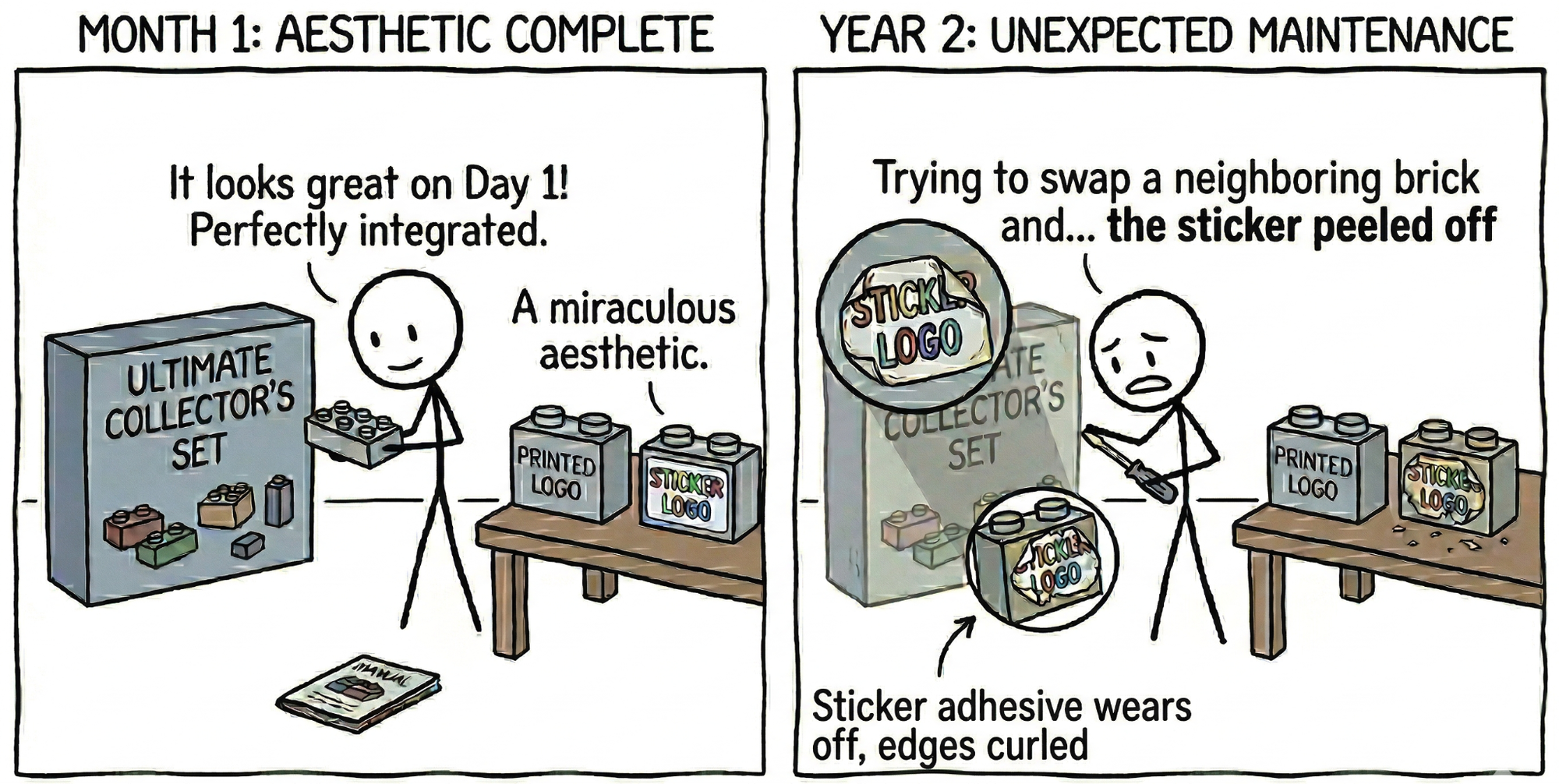
There is a distinct moment of clarity for a Master Builder when opening a premium, Ultimate Collector’s set only to find a sheet of clear plastic stickers where there should have been pre-printed bricks
From a delivery perspective, the sticker is a miracle of efficiency. It allows the project to ship faster and ensures the "box art" (the initial demo) looks fulfilled. For the first few months, the Aesthetic of a Complete Feature is achieved perfectly. But as any seasoned builder knows, a sticker isn't a feature; it’s a long-term subscription to maintenance.
Eventually, the "adhesive" of the quick-fix begins to retire. The edges curl, and the patch departs from the underlying logic, taking the component's visual identity with it. When we are forced to use a sticker, we aren’t building a masterpiece; we’re managing a countdown. A year later, while trying to swap a neighboring brick, the old "quick-win" flakes off, revealing that the feature was never actually part of the project’s DNA.
Missing pieces in bag #4
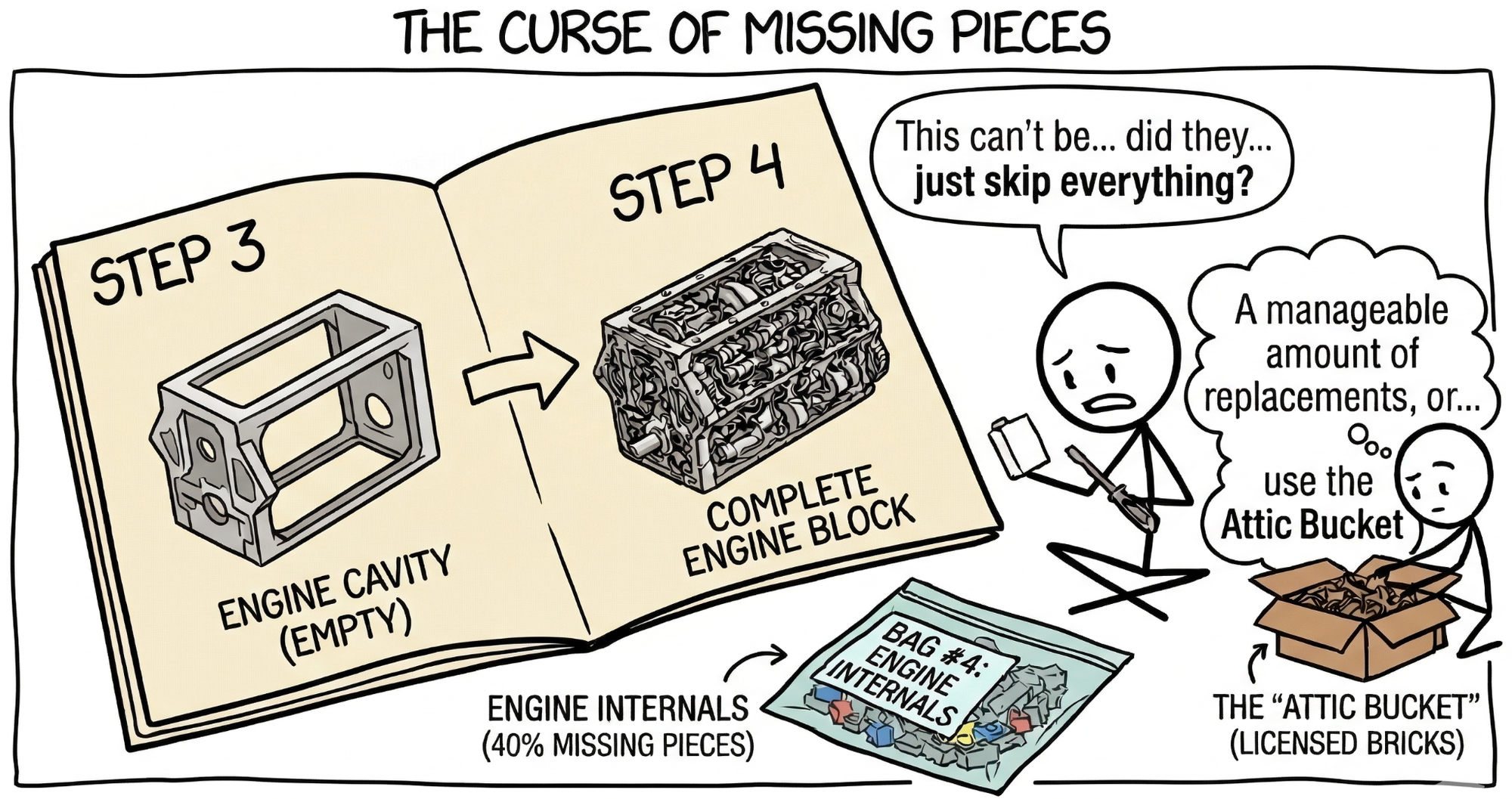
Around the midpoint of any elaborate build, there is a predictable junction where the physical parts and the logic of the manual begin to diverge. You reach for Bag #4 only to find that certain crucial components are missing, or you realize the instruction manual has skipped a schematic step entirely.
Occasionally, the manual functions more as a collection of polite suggestions than a rigorous guide. You’ll be staring at a hollow cavity of logic on one page, only for the next to reveal a fully completed engine block. In these moments, we aren't building a structural masterpiece; we’re playing a game of "fill in the blanks" to meet the estimated design.
Faced with missing pieces or vague instructions, we have two paths. We can pause to wait for the Manufacturer to provide replacements, an exercise in patience and postal-service induced hibernation, or we can improvise. We return to the "attic bucket" (the same one filled with those "licensed bricks" from Section 1) to find pieces that might fit. We fill the gaps with whichever bricks are available at the time, prioritizing the silhouette over the internal logic.
The result is a build that looks correct on the outside but contains a "hollow core" that no one else knows how to navigate. We haven't just finished a model; we’ve constructed a riddle for the next builder - who will likely be us, a year from now, during the next rebuild.
Retired part monopoly
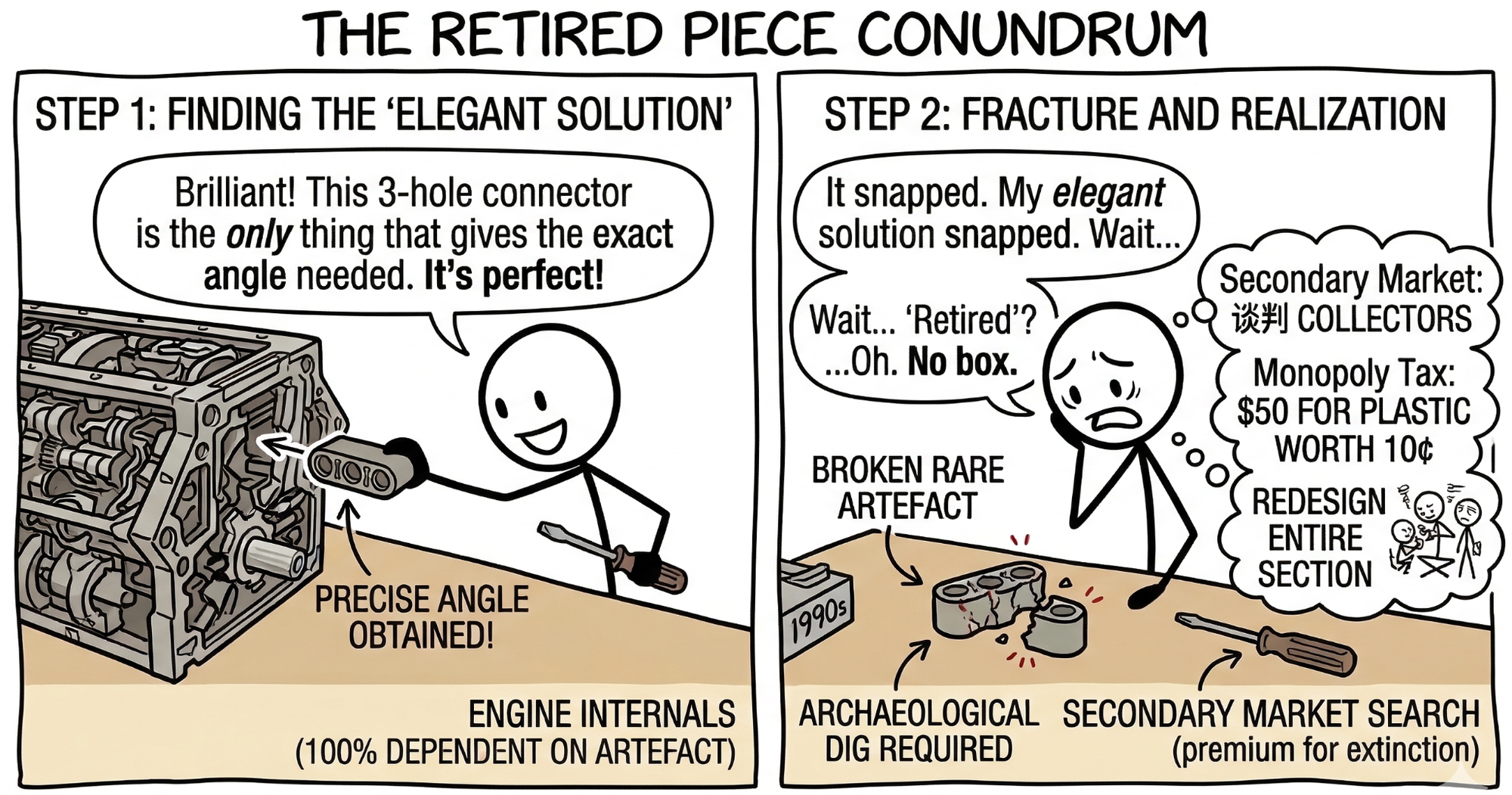
In the pursuit of the best suited components, a builder occasionally discovers a specific component - e.g a Technic 3-hole connector from the 1990s - that provides the exact structural angle needed. It is a brilliant, elegant solution, right up until the moment you realise that the part has been officially retired.
The build is now dependent on a component that is no longer manufactured. So when the build needs to be scaled, or a fractured piece needs to be replaced, the solution is not simply finding the piece on a new box; we need to embark on a high-stakes archaeological dig.
We find ourselves navigating through the “Secondary Market”, negotiating with collectors for the single piece of plastic which will now cost way more that its original value. We are paying a premium not for quality, but for extinction. The irony of the Master Builder is that a huge project can be brought to a standstill because the “Standard Foundation”, now relies on a “Rare Artefact”
Effectively we are forced to decide: do we redesign the entire section to use modern, available bricks or do we continue to pay the “Monopoly tax” on a part that everyone is afraid to touch? We haven’t just built a structure; we’ve built a museum piece that requires a specialist just to keep the lights on.
MOC purist vs the official set
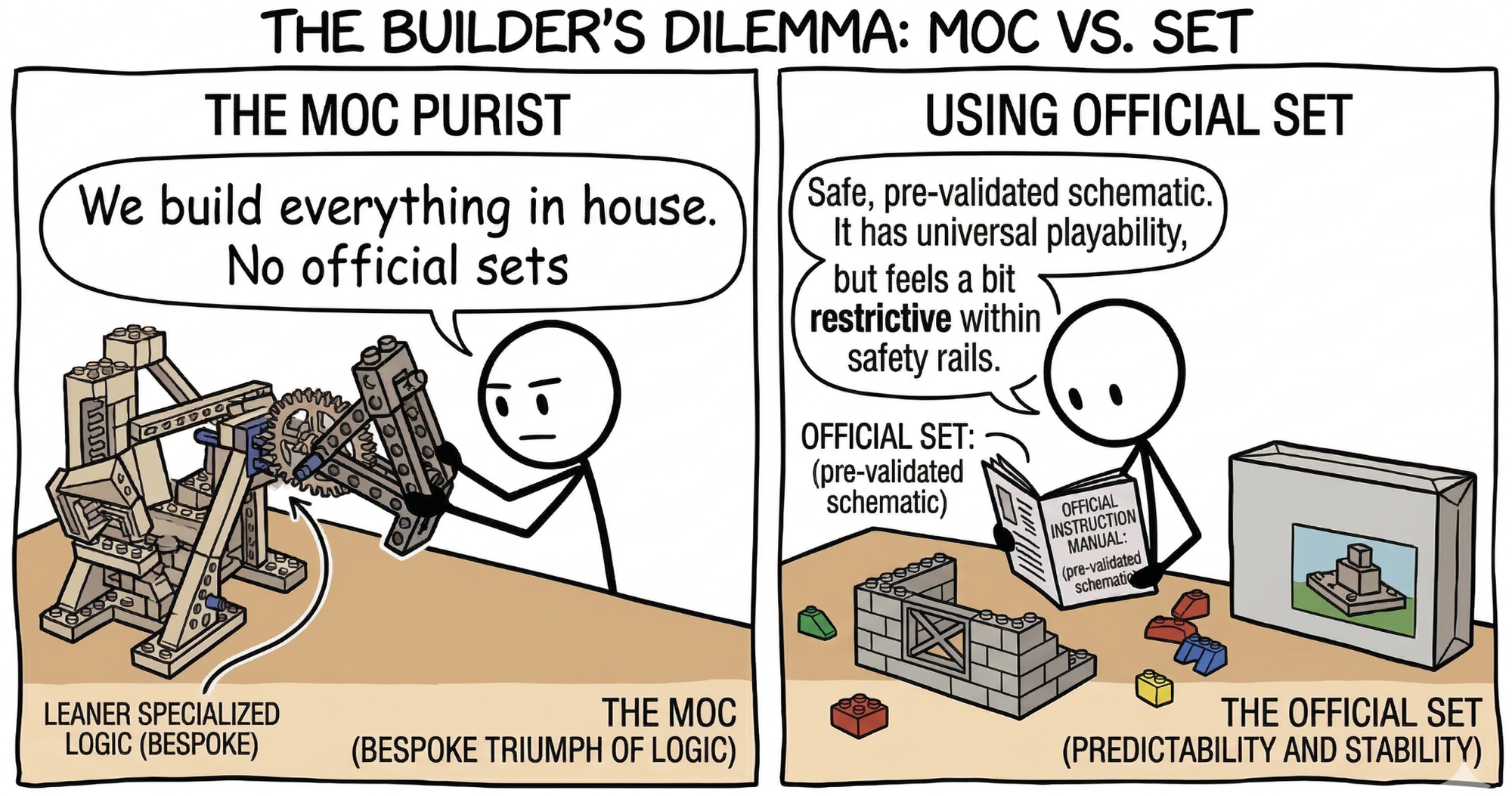
In the Master builder’s journey, a philosophical divide eventually emerges: Do we build the official set or do we strike out with a MOC (My own creation)?
The official set arrives with a pre-validated instruction manual and a structural guarantee that the roof won’t spontaneously disassemble. It is designed for universal playability, meaning that any builder can pick up the schematic and understand how the bricks connect. The trade off is a certain predictability - you are building a masterpiece within the safety rails of someone else’s imagination, restrictions and set pieces.
Then there are the MOC Purists. These builders reject the box entirely, sourcing bricks from different sets and decades to achieve their brand build. The MOC is a triumph of bespoke logic - it is leaner, more specialised and more impressive during the “Grand Exhibition”. However, it comes with a hidden overhead. Because there is no manual, or because the manual is updated slower than the actual build, the lead builder is the only person on Earth who knows that the left wing is held by a technic pin and a prayer.
To the MOC purist the official set is a restrictive compromise. To the rest of the builders this makes the MOC a brilliant, unmaintainable sculpture that no one dares to touch. A true master builder eventually realises that the most resilient projects are “Modified sets”; leveraging the stability of an official standard set, but knowing exactly when to swap in a bespoke brick structure to solve a unique problem.
Part colour inconsistency
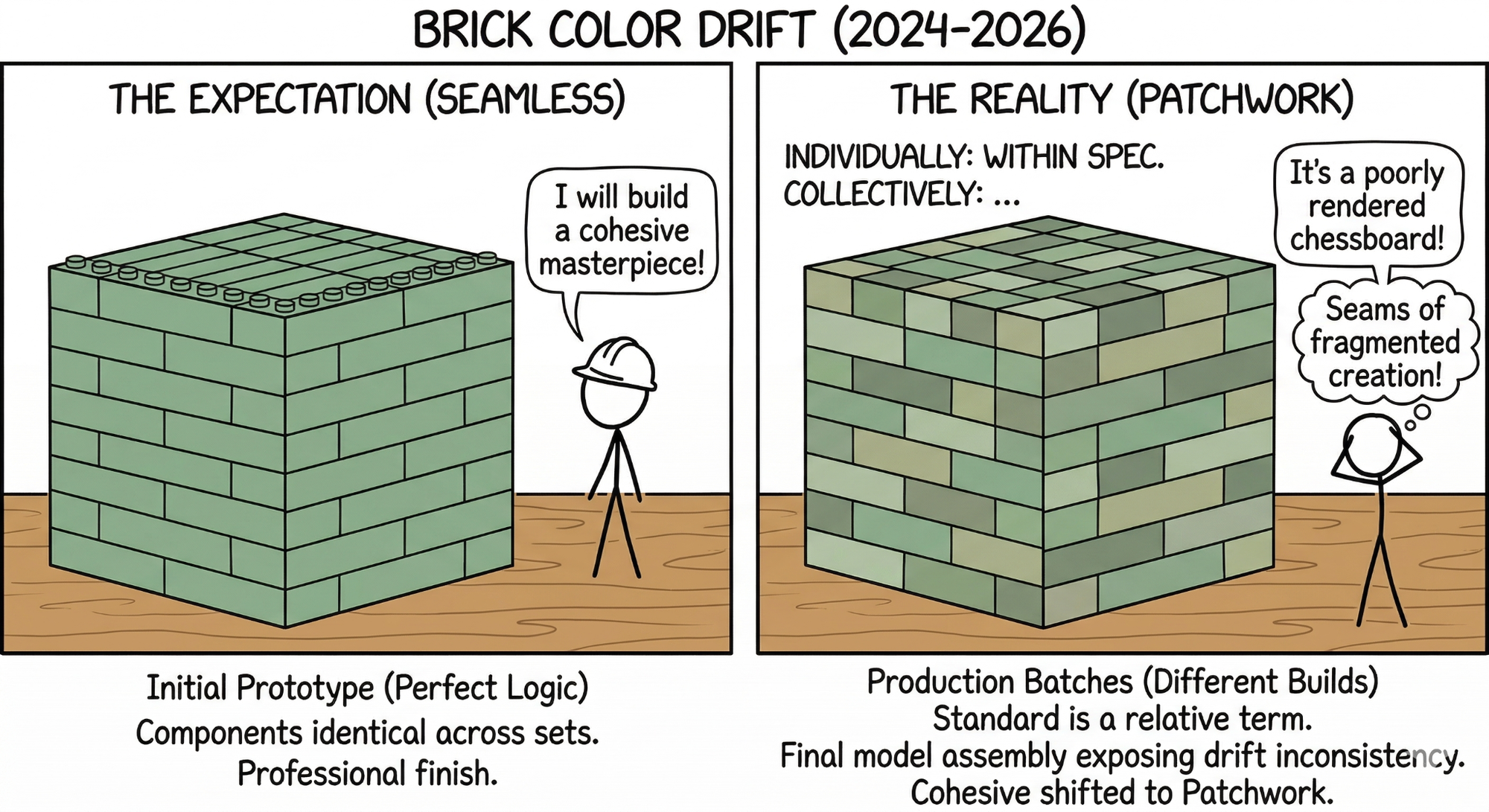
Any Master builder that has worked with sets involving specialised colour bricks like Sand Green are familiar with the subtle drift inconsistency in colour in the bricks between 2024 and 2026 (example here). Imagine building a large-scale, multi-set using those bricks, only to find that your "seamless" exterior looks less like a professional finish and more like a poorly rendered chessboard.
Whether due to different production batches, varying storage conditions, passage of time, or a slight evolution in the production assembly, one brick can appear in a lighter shade than its neighbor. Individually, each component sits within the official specification; collectively, however, they expose a lack of uniformity and parity.
Builders often assume that the components are identical across all different sets. We trust that the logic used in the initial prototype will perfectly match the one we employ in the final model assembly. But as any seasoned builder knows, a slight shift can turn a cohesive masterpiece into a patchwork quilt.
We eventually learn that the “Standard” is a relative term. We aren’t just managing simple bricks; we are managing the drift of those bricks between different builds. If we don’t account for these subtle changes in said build, even the most polished build will reveal the seams of its own fragmented creation.
The gray plate scarcity
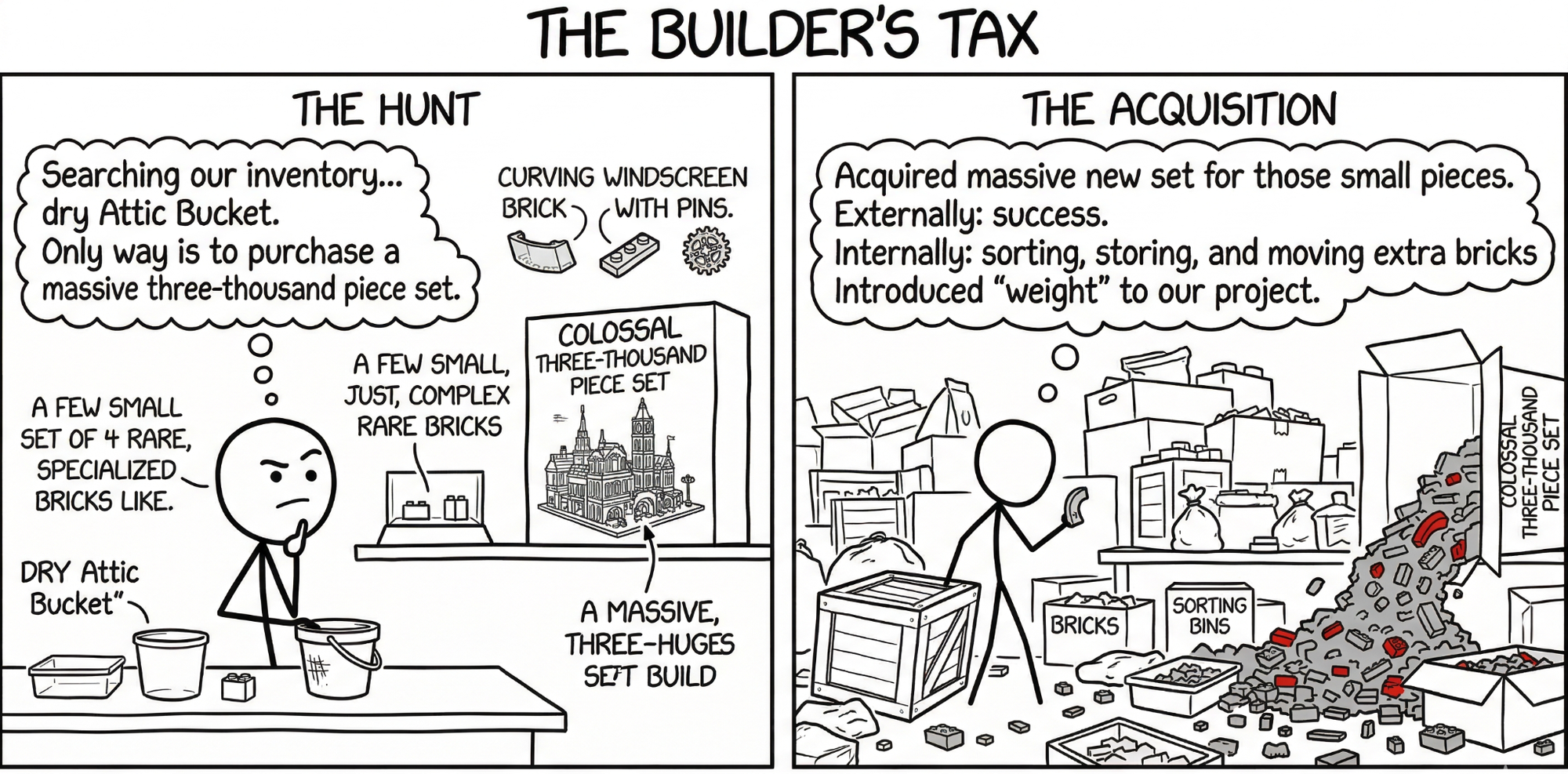
The final test of a Master builder’s restraint comes when a project requires a handful of rare specialised bricks - perhaps a Windscreen 16x8x6 curved with 3 pin holes. We’re searching our inventory, but the “Attic Bucket” is dry. We look at the current market, and the only way to acquire those specific pieces is to purchase a massive three-thousand piece set.
We found ourselves importing a massive new set into our new build, only for those small pieces that hold a specific section together. From the outside, the build is a success; but internally we’ve cluttered our inventory with thousands of extra that we have to sort, store, and move every time the project shifts. We’ve introduced a massive amount of “weight” to our project that we need to account for every time we adjust or evolve it.
As Master Builders we eventually learn that a “Complete solution” is often an expensive distraction. We must factor the convenience of the “All-in-one” box against the long term maintenance of these extra bricks. If we are not careful, we will spend significantly more time adjusting and decluttering our inventory than building our elegant masterpiece.
Conclusion
If you’ve reached this final section, you are either wondering why a deep-dive into the structural integrity of bricks is part of this tech blog, or you are experiencing a profound sense of uncanny familiarity.
As Master Builders, we like to believe we are just snapping bricks together in a vacuum. But whether we are building a 1:150 scale Star Destroyer or a global-scale data architecture, the physics of failure remain the same. We are all navigating the same "Star Wars" taxes of hype, the invisible tension of illegal shortcuts, and the peeling stickers of technical debt. We are all trying to prevent Bag #4 from being empty and hoping our “attic bucket” has the one retired connector that keeps the whole wing from falling off.
Ultimately, the price of the red lego brick isn’t just the cost of plastic, but the cumulative cost of the choices we make while assembly is underway. Whether your bricks are made of plastic, or lines of code, the goal remains the same; build something that doesn’t just look good for the photoshoot, but actually holds its own weight, when the next builder takes over the manual.
After all, gravity isn’t a suggestion. It’s a requirement.
👀 If you're still confused... (Click to reveal)
This entire article is a hidden tribute to the structural chaos software engineers face every day, disguised as a LEGO rant (and a little game to keep things interesting).
For those playing along at home, here is the cheat sheet:
- The “Star Wars” tax and the Premium of Hype → is the high cost of rewriting stable, production-tested business logic in a newer framework simply to stay current.
- Illegal building techniques → Technical debt and high-risk shortcuts.
- Sticker vs Printed pieces → Hardcoded patches and surface-level wrappers used to simulate a complete feature
- Missing pieces in bag #4 → Incomplete product requirements and undocumented upstream dependencies
- Retired part monopoly → Relying on abandoned open-source libraries, dead frameworks, or unmaintained third-party utilities
- MOC purist vs the official set → Rejecting standard industry frameworks in favour of building proprietary, bespoke platforms from scratch.
- Part colour inconsistency → Configuration drift and environmental disparity.
- The gray plate scarcity → Bloated dependency trees and package weight
The solution series
A deep-dive breakdown of each issue, along with practical architectural solutions, can be found in this two-part series (coming soon):
👉 The price of the red lego brick - The builder's challenging decisions
👉 The price of the red lego brick - The workshop fights back